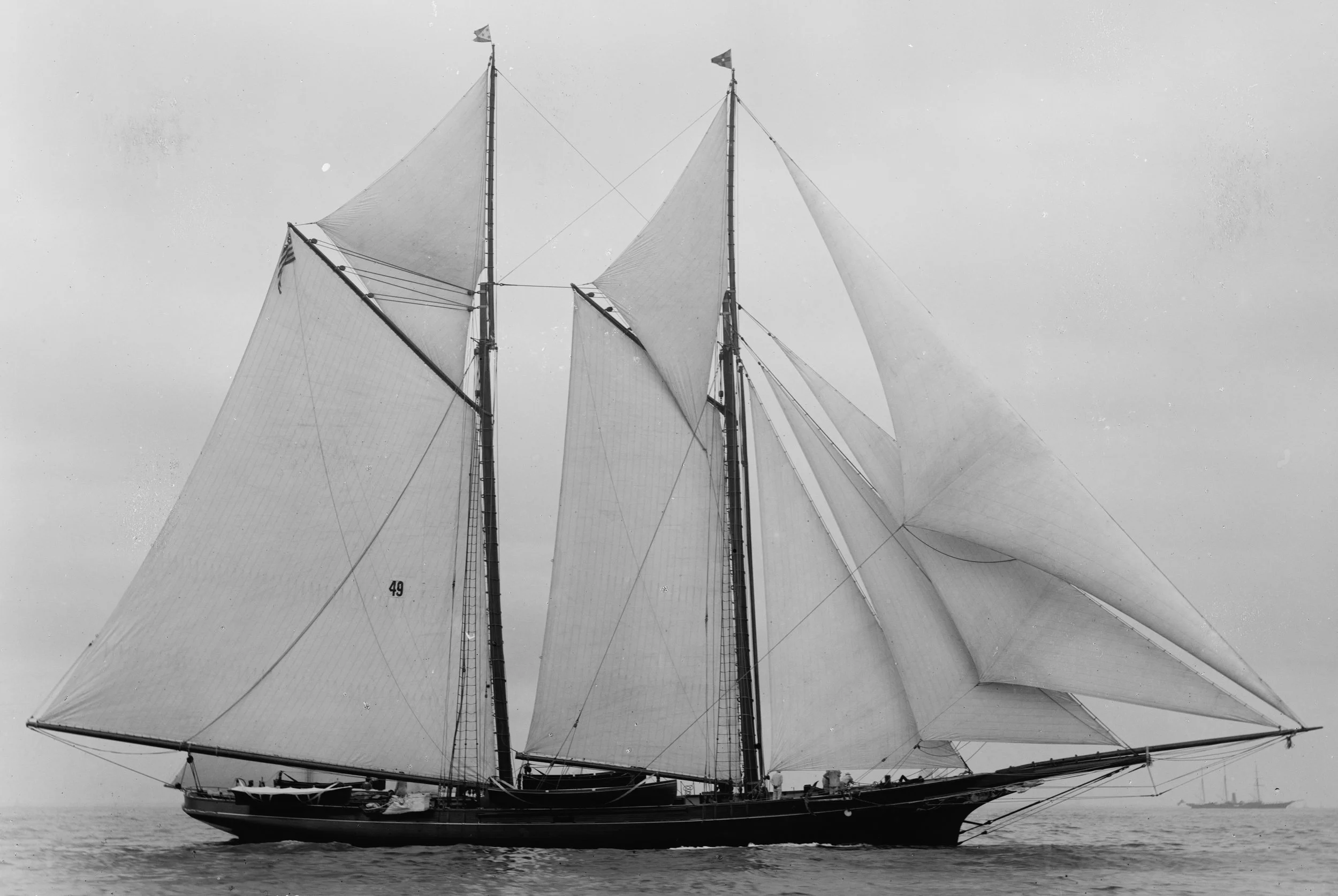
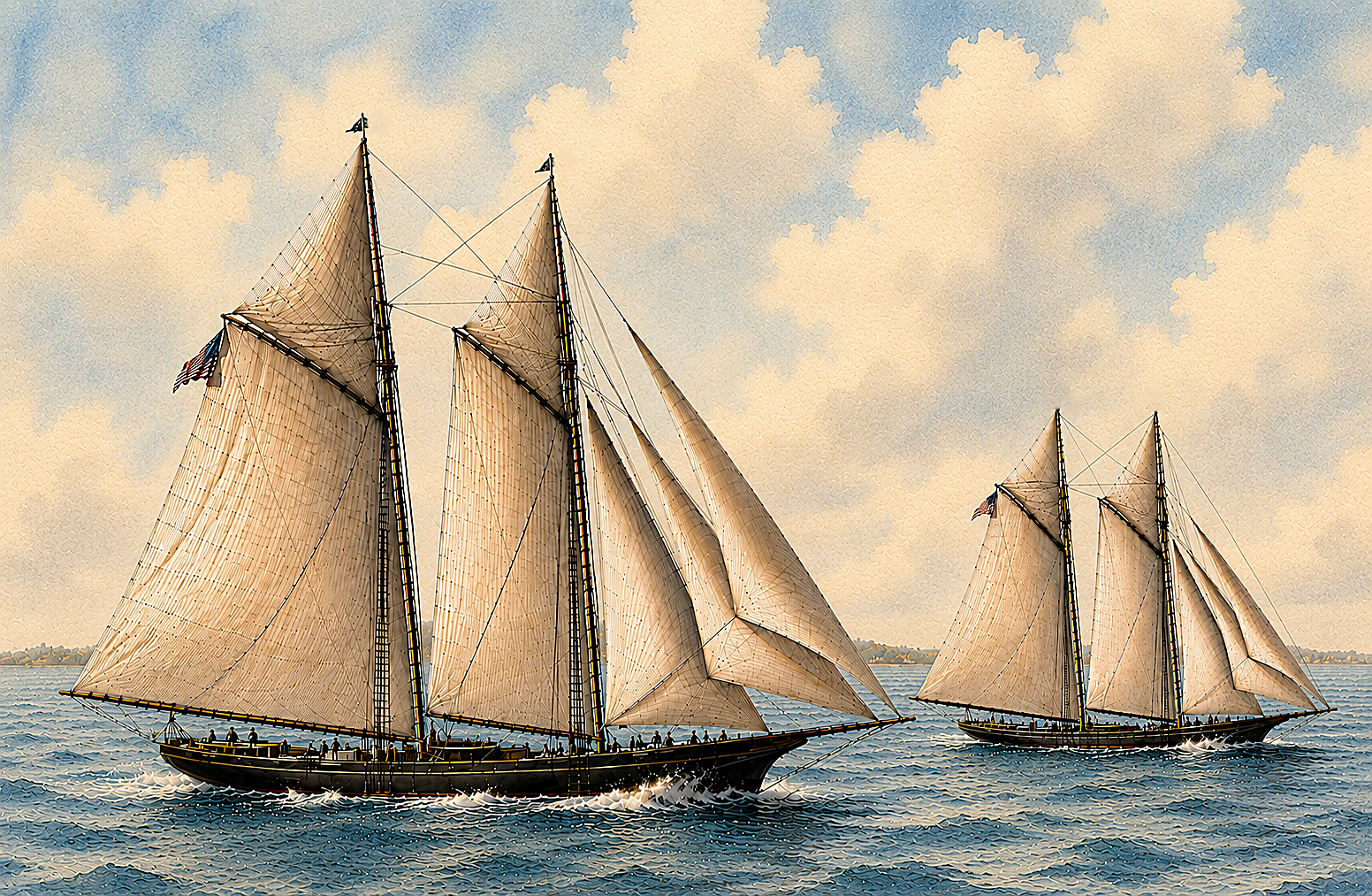
~Sappho and Columbia ~
~Winners of the 2nd Defense of the America's Cup ~1871
Twenty years after the schooner America astonished Great Britain by winning the Hundred Guinea Cup, the world's most celebrated sailing trophy faced its second great international challenge. By 1871, the America's Cup had become a powerful symbol of national pride, and thousands gathered along New York Harbor and the Atlantic approaches to witness whether the young American sailing tradition could withstand another determined British assault.
The challenger was the British schooner Livonia, owned and commanded by James Lloyd Ashbury, whose unsuccessful challenge the previous year had only strengthened his determination to reclaim the Cup for Great Britain. Having come close in 1870, Ashbury returned with a faster yacht and renewed confidence that British yacht design could finally overcome the defenders of the New York Yacht Club.
The New York Yacht Club adopted a strategy unlike any other in America's Cup history. Rather than relying upon a single defending yacht, the Club selected two remarkable American schooners—Columbia and Sappho—to share the responsibility of defending the Cup. Each yacht would compete on the courses best suited to her individual strengths, creating the only successful America's Cup defense ever shared by two different yachts.
The two defenders represented the finest achievements of nineteenth-century American naval architecture. Columbia, designed by the renowned shipbuilder William H. Webb, was a powerful and strongly built racing schooner admired for her steadiness, durability, and ability to carry sail confidently in heavy weather. Sappho, designed by the legendary Donald McKay, was longer, lighter, and exceptionally fast, celebrated on both sides of the Atlantic for her graceful lines and extraordinary turn of speed. Together they demonstrated two distinct but equally successful approaches to American yacht design.
The 1871 America's Cup series was contested over the demanding waters of Lower New York Harbor and the Atlantic approaches off Sandy Hook. The courses challenged every aspect of competitive sailing, requiring the yachts to navigate shifting tides, variable coastal winds, and open-ocean swells. Success depended not only upon superior yacht design but also upon exceptional seamanship, tactical judgment, and flawless coordination between captain and crew.
Columbia opened the series with a convincing victory, immediately demonstrating the strength of the American defenders. In the second race, however, Columbia suffered damage that allowed Livonia to claim her only victory of the series. Rather than continue with a compromised yacht, the New York Yacht Club substituted Sappho, whose remarkable speed and refined handling quickly proved decisive.
Sappho dominated the remaining races, defeating Livonia with confidence and securing the 1871 America's Cup by a margin of four races to one. The combined victories of Columbia and Sappho ensured that the Cup remained safely in American hands while showcasing the depth of talent within the New York Yacht Club fleet.
The defense of 1871 established an important milestone in America's Cup history. It demonstrated that the competition had evolved beyond a contest between individual yachts into a national showcase of naval architecture, craftsmanship, innovation, and sailing excellence. The success of Columbia and Sappho reinforced America's growing reputation as the world's leading builder of racing yachts and strengthened the prestige of the New York Yacht Club as the guardian of the America's Cup.
No other America's Cup defense has ever been won in quite the same manner. The shared triumph of Columbia and Sappho remains unique in the long history of the competition, illustrating the confidence the New York Yacht Club placed in the remarkable diversity of American yacht design. Together, these two schooners proved that victory could be achieved not through a single champion, but through the combined excellence of two extraordinary yachts.
Masters of the Wind commemorates this unique chapter in maritime history through a museum-quality presentation featuring restored historic imagery, authentic race charts, and carefully researched historical details. Each handcrafted piece preserves the story of the only successful shared defense of the America's Cup, celebrating Columbia, Sappho, and the remarkable partnership that secured one of sailing's most enduring traditions.