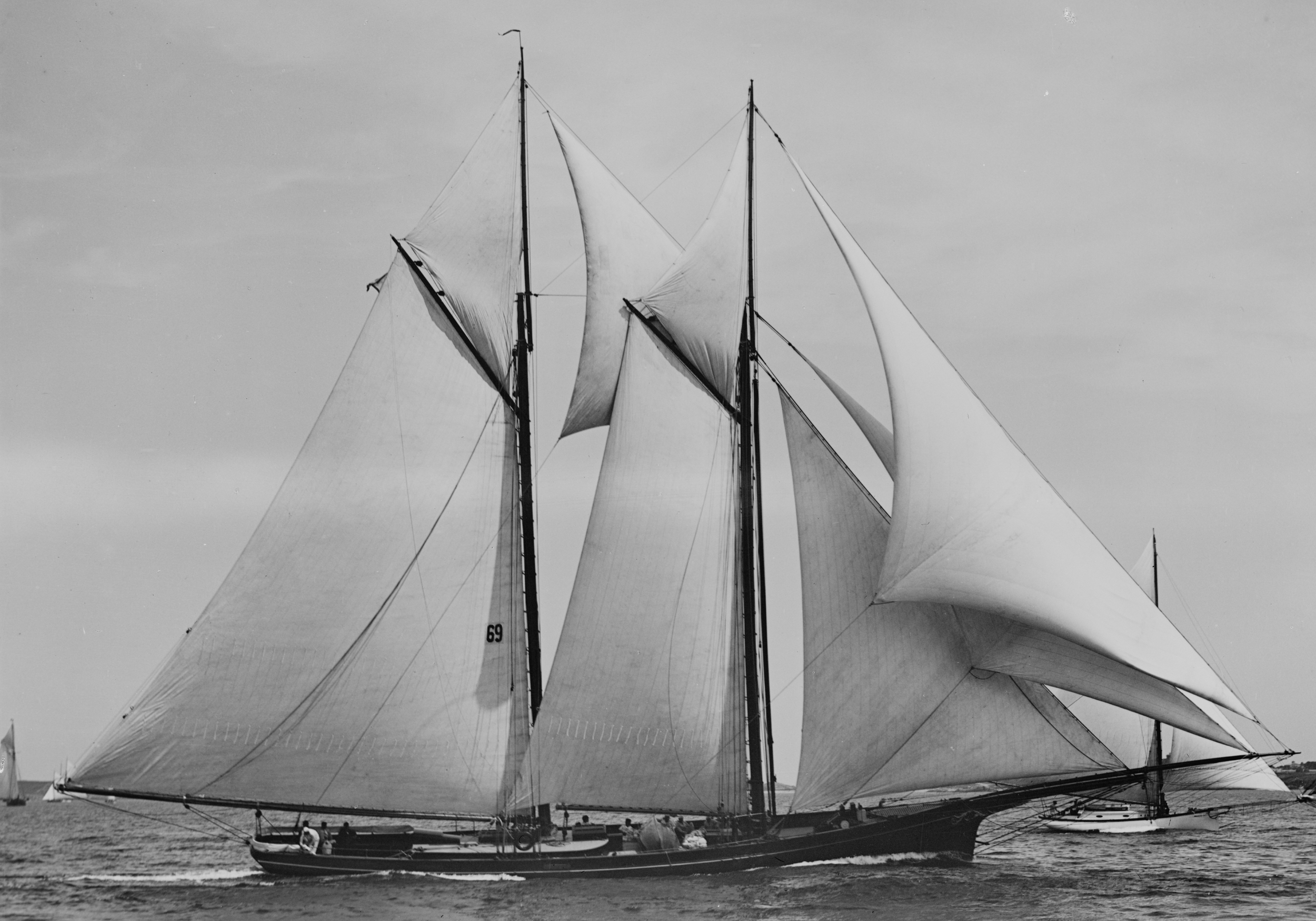
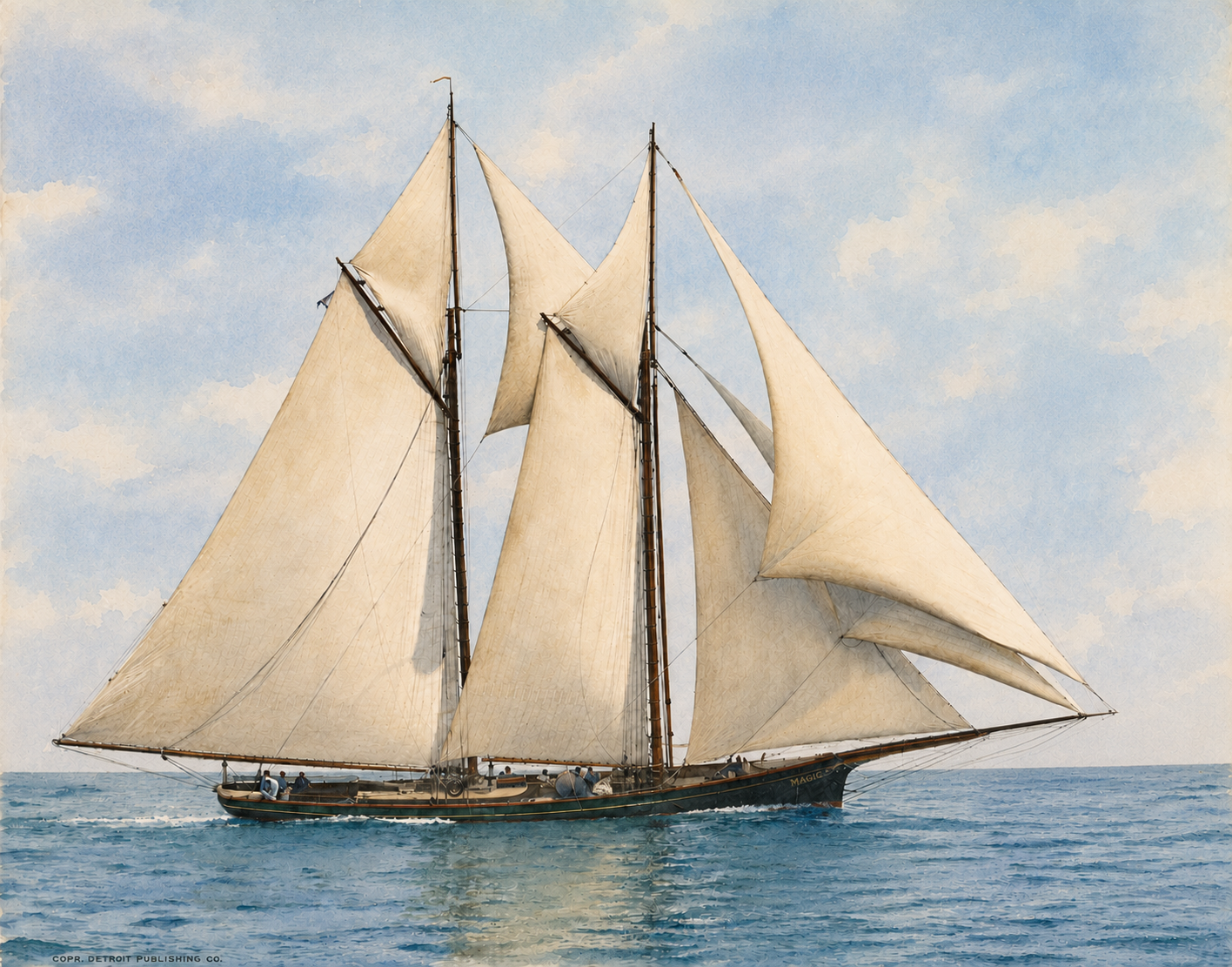
~Magic~
Winner of the First America's Cup Defense ~1870
Nineteen years after the schooner America astonished Great Britain by winning the Hundred Guinea Cup in 1851, the treasured trophy faced its first official challenge on American waters. The yacht chosen to defend the honor of the New York Yacht Club was not the famous schooner America herself, but a smaller and remarkably capable racing schooner named Magic. Her unexpected victory in the 1870 America's Cup marked the beginning of more than a century of successful American defenses.
The challenge came from James Lloyd Ashbury, a distinguished English yachtsman who crossed the Atlantic aboard his schooner Cambria determined to return the Cup to Great Britain. Since America's historic victory around the Isle of Wight, the trophy had become known as the America's Cup, and Ashbury believed the time had come to reclaim it for British sailing.
The rules governing the competition were very different from those of the modern America's Cup. Rather than selecting a single defending yacht, the New York Yacht Club invited an entire fleet of American yachts to compete against the lone British challenger. Seventeen American yachts answered the call, including celebrated vessels such as America, Dauntless, Phantom, and the comparatively modest schooner Magic.
Originally launched in 1857 under the name Madgie, Magic had undergone several refinements before her owner, Franklin Osgood, commissioned an extensive rebuild that transformed her into a formidable racing yacht. Lengthened, broadened, and carefully refined, she combined exceptional speed with remarkable agility. Her centerboard design allowed her to sail efficiently in the varied conditions of New York Harbor while competing successfully against yachts considerably larger than herself.
Although Magic possessed impressive performance, few expected the relatively small schooner to defeat the larger and more famous defenders. Much of the attention centered on the legendary yacht America, whose name had become synonymous with the Cup itself. Magic entered the race as an underdog, respected by knowledgeable yachtsmen but largely overlooked by the public.
On August 8, 1870, eighteen yachts crossed the starting line off Staten Island, beginning a spectacular race through New York Harbor toward Sandy Hook and back over a course of approximately forty nautical miles. The brilliant display of white canvas against the summer sky created one of the most memorable spectacles in nineteenth-century American sailing.
From the opening miles, Magic demonstrated that superior handling could overcome greater size. Her centerboard enabled her to point higher into the wind, tack efficiently, and maintain impressive speed through changing conditions. While Cambria found herself surrounded by the powerful American fleet, Magic steadily established herself at the front of the race.
Under skillful seamanship, Magic maintained her advantage throughout the demanding course. After more than three and a half hours of racing, she crossed the finish line first, securing victory in the first successful defense of the America's Cup. The legendary yacht America finished fourth, while the British challenger Cambria crossed the line in tenth place.
Although the result confirmed the continued supremacy of American yacht design and seamanship, it also sparked one of the earliest controversies in America's Cup history. James Lloyd Ashbury argued that requiring a single challenger to compete against an entire fleet of defenders was fundamentally unfair. From his perspective, Cambria had been forced to race seventeen American yachts simultaneously rather than a single defending champion.
His objections were not without influence. In the years that followed, the rules governing the America's Cup evolved, eventually establishing the familiar one-on-one format between a single defender and a single challenger that defines the competition today. The controversy surrounding the 1870 America's Cup therefore helped shape the future of one of the world's greatest sporting events.
Although the yacht America gave the America's Cup its name, it was Magic that secured the Cup's first successful defense and demonstrated that American innovation and seamanship remained unmatched nearly two decades after the famous victory of 1851. Her triumph affirmed the strength of American yacht design and ensured that the Cup would remain in the hands of the New York Yacht Club for generations to come.
Masters of the Wind commemorates the remarkable achievement of the yacht Magic through a museum-quality presentation featuring restored historic imagery, authentic race charts, and carefully researched historical details. Each handcrafted piece preserves the story of the first successful America's Cup defense, celebrating the yacht, her crew, and the race that strengthened one of sailing's greatest traditions.